Law
Non-Compete Agreement Review: What to Check Before You Sign in 2026

Key Takeaways
- A non-compete agreement limits the work you can do after a job or deal ends; courts usually look at duration, geography, scope and what you received for signing.
- The FTC's 2024 nationwide non-compete rule was set aside by a federal court before it took effect, so state law still decides most questions.
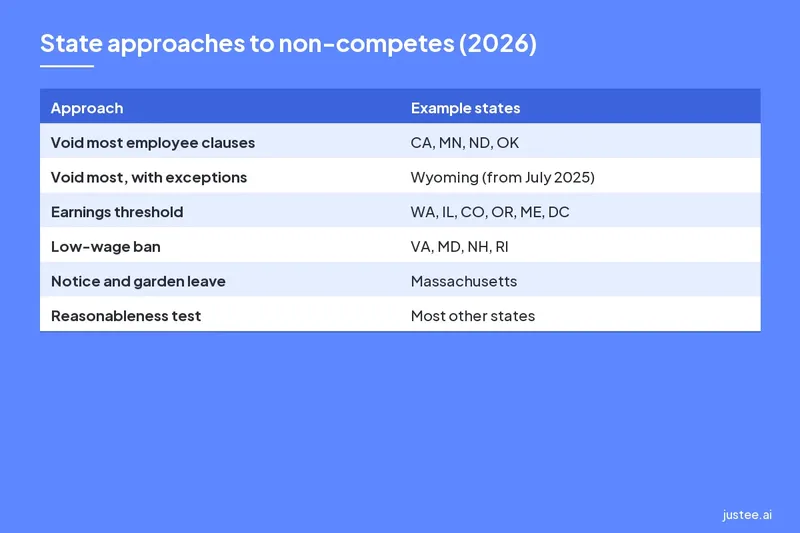
- California, Minnesota, North Dakota and Oklahoma void most employee non-competes; other states use income thresholds, low-wage bans, notice rules or a reasonableness test.
- Non-competes signed when selling a business are generally treated more leniently than employee non-competes.
- AI-assisted review can flag and explain restrictive clauses; for advice on your own agreement, talk to a lawyer.
A non-compete agreement is a contract term that limits the work you can do, or the business you can start, after a job or business relationship ends. It often arrives at a busy moment: inside an offer letter, buried in an employment contract, attached to a severance agreement, or folded into the closing documents when a company is sold. In each case the clause can shape your next year or more of work, and the rules that decide whether it holds up vary sharply from state to state.
This guide explains how a non-compete agreement is built, where U.S. law stands as of November 2026, which clauses deserve a slow read, and how an AI-assisted review with Justee can help you understand the document before you sign. It is written for employees weighing an offer, HR professionals who send these agreements, founders who sign them with investors or buyers, and anyone else who has been handed one with a deadline attached.
It is legal information, not legal advice. Justee is not a law firm, and nothing here is a substitute for the advice of an attorney; for advice on any contract, routine or not, talk to a lawyer.
A non-compete agreement (also called a covenant not to compete or a restrictive covenant) is a promise not to work for a competitor, or start a competing business, for a set time in a set area after a relationship ends. In the United States there is no nationwide ban in force: the Federal Trade Commission's 2024 rule was set aside by a federal court in August 2024, before its effective date, so state law controls. California, Minnesota, North Dakota and Oklahoma void most employee non-competes. Many other states allow them only above an income threshold, bar them for low-wage workers, or require advance notice. Where they are allowed, courts usually ask whether the restriction protects a legitimate business interest, such as trade secrets or customer relationships, and whether its duration, geography and scope are reasonable. Non-competes signed as part of selling a business are generally judged more leniently than those signed by employees.
What a non-compete agreement actually restricts
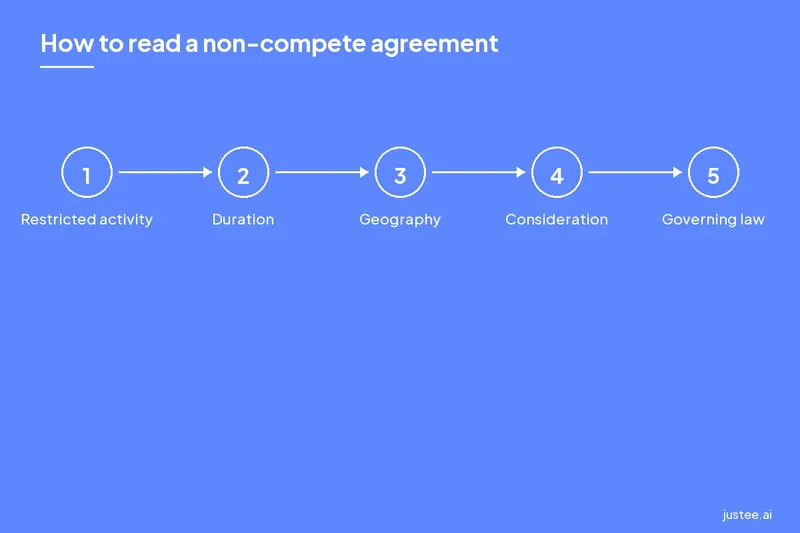
Most non-compete clauses are built from the same four parts. Reading them one at a time makes a dense paragraph far easier to understand.
- The restricted activity. What you may not do: work for a competitor, start a competing business, invest in one, or perform a particular kind of work. The definition of "competitor" or "competing business" usually decides how broad the clause really is.
- The duration. How long the restriction lasts after the relationship ends. Six months, one year and two years are common in employee agreements; sale-of-business covenants often run longer.
- The geography. Where the restriction applies: a radius around an office, a list of counties or states, the territory you covered, or sometimes "anywhere the company does business."
- The consideration. What you receive in exchange: the job itself, a bonus, equity, severance pay, or, in a business sale, the purchase price.
The legal background for these parts is the common-law "reasonableness" test that most states still apply. The Legal Information Institute at Cornell Law School summarizes it this way: a covenant not to compete is generally enforced only if it protects a legitimate interest of the employer and is reasonable in time, area and scope. Legitimate interests usually include trade secrets, confidential information and customer goodwill. A general wish to avoid competition, on its own, usually is not enough.
Related clauses that often travel with it
A non-compete rarely appears alone. The same agreement often contains several other restrictive covenants, and each one works differently:
- A non-solicitation agreement limits approaching the employer's customers or employees, but does not stop you from working for a competitor.
- A confidentiality agreement or NDA limits using or disclosing confidential information, usually with no end date for trade secrets.
- A no-hire or no-poach clause limits recruiting former colleagues.
- An invention assignment agreement decides who owns work you create, which matters if you plan to build something similar later.
This matters because a state that voids non-competes may still allow a narrow non-solicitation or confidentiality clause. When people say their non-compete agreement "does not apply in my state," they sometimes overlook the neighbouring clauses that may still bind them. Whether each clause applies to you is a question for a lawyer.
Where non-compete law stands in 2026
The biggest change in recent years is one that did not happen. In April 2024 the Federal Trade Commission adopted a rule that would have banned most new non-competes nationwide. In announcing it, the FTC estimated that about 30 million workers, roughly one in five Americans, were bound by a non-compete. In August 2024, before the rule's effective date, a federal district court in Texas set the rule aside in Ryan LLC v. FTC, and in 2025 the FTC withdrew its appeals. The rule never took effect. The FTC's noncompete rule page documents that history, and the agency has said it may still challenge specific non-competes case by case. For an individual reading an agreement today, the practical point is simple: state law decides most questions.
States that void most employee non-competes
- California. Business and Professions Code section 16600 voids contracts that restrain anyone from a lawful profession, trade or business, subject to narrow exceptions such as the sale of a business. Since 2024, section 16600.5 also addresses agreements signed outside California, and employers were required to notify many current and former employees that their non-compete clauses were void.
- Minnesota. Minnesota Statutes section 181.988 voids most employee and independent contractor non-competes entered into on or after July 1, 2023.
- North Dakota and Oklahoma. Both have long-standing statutes that void most non-competes, with exceptions such as the sale of a business; Oklahoma permits limited non-solicitation of established customers.
- Wyoming. A 2025 law voids most new non-competes from July 1, 2025, with exceptions that include certain executive and management personnel, trade secret protection and the sale of a business.
States that use income thresholds or low-wage bans
A second group of states allows non-competes only for higher earners or bars them for lower-paid workers. Washington's RCW chapter 49.62 sets an earnings threshold that is adjusted each year and requires the terms to be disclosed in writing no later than the time the offer is accepted. Illinois, Colorado, Oregon, Maine and the District of Columbia also use earnings thresholds. Virginia Code section 40.1-28.7:8 bars non-competes for low-wage employees, and Maryland, New Hampshire and Rhode Island have similar protections. Thresholds change, so the current figure for your state is something to check in the statute itself or with a lawyer.
States that regulate the process
Some states focus on how the agreement is presented. The Massachusetts Noncompetition Agreement Act requires a signed writing, advance notice, a statement that the employee may consult a lawyer, a restricted period that generally may not exceed 12 months, and either garden leave pay or other agreed consideration. Several other states add notice periods or require that a non-compete for an existing employee come with something new in return.
States moving the other way
Not every change narrows non-competes. Florida enacted a law in 2025 that makes certain non-competes for higher-earning workers easier to enforce, provided the agreement meets the statute's notice and drafting requirements. In most remaining states, courts apply the reasonableness test case by case, and many will narrow an overbroad clause rather than strike it.
This snapshot reflects the law as of November 2026. Legislatures revisit restrictive covenants often, so checking the current statute for your state, and talking to a lawyer about your agreement, is the reliable way to know where you stand.
The non-compete clauses to read closely
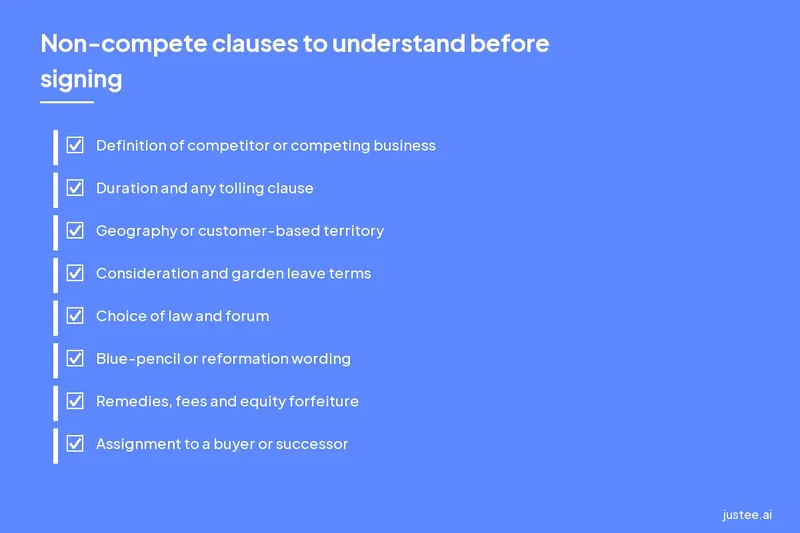
Once you know the four building blocks, the next step is the fine print around them. These are the provisions that most often change what a non-compete agreement means in practice.
The definition of a competitor
A clause that bars work for "any business that competes with the Company" can be far broader than one that names specific products, services or customers. Look for whether the definition covers the employer's affiliates, future lines of business, or businesses the employer was only "planning" to enter. A broad definition can reach roles that have nothing to do with the work you actually did.
Duration and tolling
Beyond the headline period, some agreements include a tolling clause, which pauses or extends the restriction for any time you are found to be in breach. Others start the clock from the end of a consulting period or a severance period rather than your last day of work. Both can make a one-year restriction last noticeably longer.
Geography and the remote-work problem
Radius-based restrictions were written for office jobs. For remote roles, agreements increasingly use "any territory in which the Company does business" or a list of customers instead. A customer-based restriction can be narrower in practice, but a worldwide territory with no customer link is the kind of term courts in many states examine closely.
Consideration and garden leave
Check what you receive for agreeing. In some states, continued employment alone may not be enough to support a non-compete signed mid-employment. Garden leave, where the employer keeps paying you during the restricted period, is required in some form in Massachusetts and is sometimes offered elsewhere. Note whether payment is conditional, whether the employer can waive the restriction to stop paying, and how much notice it must give.
Choice of law and choice of forum
Many agreements say they are governed by the law of the employer's home state and that disputes must be brought there. That can matter a great deal if you live in a state with stronger worker protections. California Labor Code section 925, for example, limits requiring employees who primarily live and work in California to accept another state's law or forum as a condition of employment, with an exception where the employee was individually represented by a lawyer in negotiating the terms.
Blue-pencil, reformation and severability
If a clause is too broad, states take different approaches. Some courts strike the overbroad words and enforce the rest ("blue-penciling"), some rewrite the clause to something reasonable (reformation), and some refuse to enforce it at all. Many agreements include a clause inviting a court to narrow the restriction. That language does not decide the outcome, but it tells you the drafter expected the question.
Remedies, fees and forfeiture
Look for an agreement that the employer can seek an injunction without posting a bond, a liquidated damages figure, a clause shifting legal fees to the losing party, or a provision that forfeits unvested or even vested equity if you compete. Equity forfeiture clauses, sometimes called forfeiture-for-competition provisions, may be analysed differently from a traditional non-compete in some states.
Assignment and notice duties
Some agreements let the employer assign the non-compete to a buyer or successor, which means a company you never worked for could later enforce it. Others require you to show the agreement to any future employer, or to tell your former employer where you are going next.
Justee is designed to help people understand a non-compete agreement before they sign it. It assists your judgment, and for advice on your own situation, talk to a lawyer.
Review your non-compete agreement
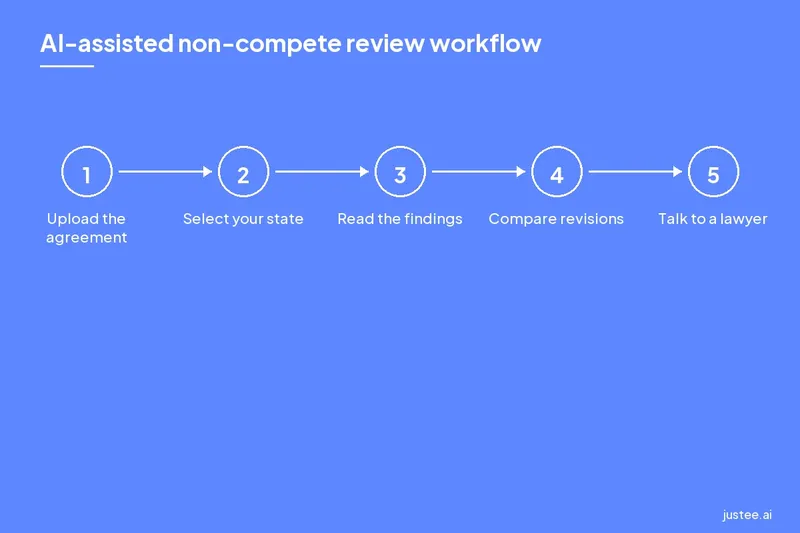
Upload a PDF or DOCX, or paste the text, choose a U.S. state, and see restrictive terms flagged as Critical, Moderate or Note, typically in 1 to 6 minutes.
Review a non-competeNo credit card requiredResults in minutesAES-256 encryption
How a non-compete agreement shows up in real situations
The same clause can mean different things depending on when and why it was signed. These are the situations in which people most often meet one.
A new job offer
For many employees, the first sight of a non-compete is an attachment to an offer. Washington and Massachusetts require advance disclosure, and several other states have notice rules. Reading the agreement alongside the offer letter helps show whether bonuses, equity or severance are tied to it. Our employment contract review guide covers the wider document.
Mid-employment
Employers sometimes introduce non-competes to existing staff, often with a promotion, an equity grant or a handbook update. Whether continued employment is enough consideration varies by state. The employee handbook review guide explains how handbook policies differ from signed agreements.
Severance and separation
Separation agreements sometimes add or extend a non-compete in exchange for severance pay. That can change the consideration analysis and the duration. The severance agreement review checklist covers the release and other terms that usually sit beside it.
Selling a business
When an owner sells a company, the buyer pays partly for goodwill, and a non-compete helps preserve it. Courts in most states, including California under its statutory exception, treat these covenants more leniently than employee non-competes. Related terms often appear in a buy-sell agreement or shareholder agreement.
Founders and equity holders
Founders frequently sign restrictive covenants with co-founders and investors, often inside a founders agreement or stock purchase documents. These can be treated as owner covenants rather than employee covenants, which may change how a court reviews them.
Independent contractors and freelancers
Some states, including Minnesota, extend their non-compete rules to independent contractors. Freelancers may find restrictions in a master services agreement or an independent contractor agreement, sometimes phrased as a ban on working directly for the client's customers.
Healthcare and licensed professions
Many states have specific rules for physicians, nurses and other healthcare workers, and some limit non-competes for broadcasters, lawyers or other professions. If you work in a licensed field, the profession-specific rule may matter more than the general one.
How AI-assisted review with Justee fits
A non-compete agreement is short, but its meaning depends on the definitions, the rest of the contract and your state's law. AI-assisted review is designed to make that first read faster and more complete, so you know what to ask before you sign.
According to Justee, a review accepts PDF or DOCX files, including scanned PDFs, or pasted text. You choose the U.S. state that applies, and according to Justee, any U.S. state can be selected, with one jurisdiction per document on the free trial and up to two on paid plans. Two jurisdictions can be useful when the agreement chooses one state's law and you live and work in another.
According to Justee, a review typically takes 1 to 6 minutes, and each finding is rated Critical, Moderate or Note. The review draws on a reference library of over 1 million sections of U.S. and England & Wales legislation, which helps connect a clause in your non-compete agreement to the statute Justee identifies as relevant. You can start from the non-compete agreement review page.
In Justee, each finding is rated Critical, Moderate or Note, so it is easier to see which restrictive terms to read first.
Three other tools fit a non-compete workflow:
- Justee Legal AI Chat. Justee Legal AI Chat gives general legal information, for example what "tolling" or "garden leave" means. It does not draft letters or filings for your matter.
- Justee Document Comparison. If the employer sends a revised draft, Justee Document Comparison lists the changes by type: insertion, deletion, replacement and, for PDFs, visual changes. It is rule-based, does not use AI, and does not explain what a change means.
- Justee PII Redaction Tool. If you want to paste an agreement into another AI tool, the Justee PII Redaction Tool accepts PDF and DOCX and detects names, organizations, addresses, contact details, dates of birth, and government and financial ID numbers on a best-effort basis. It does not detect amounts such as salaries. Redaction reduces how much personal data reaches an AI model; it does not by itself make a workflow compliant with any privacy law.
On privacy: documents are processed on Justee's servers, which are hosted on AWS and encrypted in transit (TLS 1.2+) and at rest (AES-256). Guest files are deleted after 24 hours. Full Private Mode is optional on paid plans: Justee's servers process the document, then seal the result with a key only you hold, and it covers only the items made with it on. Plans are listed on the pricing page.
AI-assisted review has limits. It can miss things, and it cannot know facts outside the document, such as which customers you actually served or what confidential information you saw, which often decide how a court views a non-compete. Justee assists your judgment; for advice on your agreement, talk to a lawyer.
Reading a non-compete agreement yourself vs AI-assisted review
| Task | Reading it yourself | AI-assisted review with Justee |
|---|---|---|
| Finding restrictive clauses | Careful read of every section | Flags terms rated Critical, Moderate or Note |
| State law context | Look up your state's statute | Checks against the selected U.S. state |
| Typical time | Varies with length | Typically 1 to 6 minutes |
| Comparing a revised draft | Side-by-side reading | Document Comparison lists changes by type |
| Explaining terms | Guides and statutes | Legal AI Chat gives general information |
| When to talk to a lawyer | For advice on any contract | For advice on any contract |
* This table describes general approaches, not a test or ranking. AI-assisted review is designed to help you understand a document and can miss things; it is legal information, not legal advice. For advice on any contract, routine or not, talk to a lawyer.
Common questions people raise about a non-compete
People who receive a non-compete often have questions for the other side before signing. This section describes common requests; it is not a recommendation for your situation, and whether any of them fits your agreement is a question for a lawyer.
- A narrower definition of competitor. Many people ask for the restriction to name specific products, services or direct competitors rather than "any competing business."
- A customer-based restriction instead of a territory. Common requests include replacing a broad geography with a list of customers the person actually worked with.
- A shorter duration or no tolling. Some people ask for a shorter restricted period, or for the tolling clause to be removed.
- Garden leave or other payment. Some ask whether the employer will pay during the restricted period, or whether the restriction ends if the employer terminates without cause.
- Carve-outs. Common requests include exceptions for prior clients, passive investments, teaching, or side work in an unrelated field.
- Home-state law. Some people ask for the agreement to follow the law of the state where they live and work.
It also helps to keep a copy of every version you receive and to note what was said about the agreement during hiring. If a revised draft arrives, a rule-based comparison shows exactly which words changed. Understanding the terms before you sign is the goal; how to respond to a specific offer is a conversation to have with a lawyer.
When to talk to a lawyer
A non-compete agreement can affect where you work, whether you can start a business and whether you keep equity. It is not a substitute for the advice of an attorney to read a guide or run an AI review; for advice on any contract, routine or not, talk to a lawyer. That includes questions about whether a clause is enforceable against you, how your state's threshold applies to your pay, what happens if you have already signed, and what a former employer can do if you take a new role. Many state bar associations run lawyer referral services, and some employment lawyers offer short consultations.
If you are an HR professional or founder preparing a non-compete for others, the same applies: state notice rules, thresholds and drafting requirements change, and a lawyer licensed in the relevant states can advise on your documents.
“In my view, a non-compete is easiest to understand when you read it as four separate questions: what work is restricted, for how long, where, and what was given in exchange. People often focus on the length of the restriction and pass over the definition of a competitor, which is usually where the real breadth of the clause sits. A tool can help surface those definitions quickly, but the question of how they apply to a particular career belongs with a lawyer.”
This is general information and opinion about how restrictive-covenant clauses tend to interact. Whether any specific term applies to you depends on your state's law and the facts, which is a question for a lawyer.
Frequently Asked Questions
Is a non-compete agreement enforceable?
It depends on the state, the type of agreement and the facts. California, Minnesota, North Dakota and Oklahoma void most employee non-competes, and Wyoming voids most new ones from July 2025 with exceptions. Other states use earnings thresholds, low-wage bans, notice rules or a reasonableness test. A clause may be unenforceable in some states; whether it is enforceable against you is a question for a lawyer.
Did the FTC ban non-competes?
No ban is in force. The FTC adopted a rule in April 2024, but a federal court set it aside in August 2024 before it took effect, and the FTC withdrew its appeals in 2025. State law continues to govern most non-competes, and the FTC has said it may still challenge specific agreements case by case.
What is the difference between a non-compete and a non-solicitation agreement?
A non-compete limits working for a competitor or starting a competing business. A non-solicitation agreement limits approaching the employer's customers or employees but does not stop you from working in the industry. Some states that void non-competes still allow narrow non-solicitation or confidentiality clauses.
Can an employer ask a current employee to sign a non-compete?
Employers do ask, often with a promotion, bonus or equity grant. Whether continued employment alone is enough consideration varies by state; some require something new in return. A lawyer can explain how your state treats agreements signed mid-employment.
Do non-competes apply to independent contractors?
They can. Some states, including Minnesota, apply their non-compete rules to independent contractors as well as employees. Freelancers often find restrictions in service agreements, sometimes framed as limits on working directly for the client's customers.
What happens if a non-compete is too broad?
States differ. Some courts strike the overbroad words and enforce the rest, some rewrite the clause to something reasonable, and some decline to enforce it at all. The agreement's own severability or reformation clause does not decide the outcome, but it signals how the drafter expected a court to approach it.
Can Justee review a non-compete agreement?
Yes. Justee accepts PDF or DOCX files, including scanned PDFs, or pasted text, lets you choose a U.S. state, and rates findings Critical, Moderate or Note, typically in 1 to 6 minutes. It provides legal information, not legal advice; for advice on your agreement, talk to a lawyer.
Understand your non-compete before you sign
Run an AI-assisted review of your non-compete agreement. Free use has page, state and usage limits; paid plans run from $16/month to $149/month, billed annually (monthly billing costs more).
Start a reviewA non-compete agreement is easier to understand when you separate its parts, check your state's current rules and read the definitions slowly. Justee can help you see the restrictive terms and the relevant statutes so you understand the terms before you sign; a lawyer can tell you what they mean for you.
Max Zaykov is the founder of Justee.ai, an AI tool that helps people understand their legal documents.
Justee is not a law firm. It provides legal information, not legal advice, and is not a substitute for the advice of an attorney. For advice on any contract, routine or not, talk to a lawyer.