Law
Independent Contractor Agreement Review: 12 Terms to Understand Before You Sign

Key Takeaways
- An independent contractor agreement sets the terms of a business relationship, but the label alone does not decide whether a worker is legally a contractor.
- The IRS, the U.S. Department of Labor and state agencies each apply their own classification tests, and those tests look at how the work is actually done.
- Ownership of the work is a frequent surprise: under U.S. copyright law, a contractor's work is often not a work made for hire unless narrow conditions are met.
- Payment, liability, insurance, restrictive covenants and termination are the other terms most often worth a second read.
- AI-assisted review can help organize questions; for advice on any independent contractor agreement, routine or not, talk to a lawyer.
An independent contractor agreement is the contract a business and a self-employed worker sign to set out the work, the price, who owns the results and how the relationship ends. Small business owners, founders and HR teams sign them when they bring in a designer, developer, consultant or sales representative, often in a hurry because a project is already late. Contractors sign them too, frequently on the hiring company's template.
This guide walks through the twelve terms that most often deserve a careful read, explains the federal and state rules that sit behind them, and shows where a tool such as the Justee independent contractor agreement review fits in. It is written mainly from the hiring business's side, with notes for contractors; freelancers reading their own client contracts may also find the freelance contract review guide useful. It is legal information for understanding the document, not legal advice about any particular working relationship.
An independent contractor agreement is a contract between a business and a self-employed person or company that defines the services to be performed, the fees, the deliverables, ownership of work product, confidentiality, liability and termination. It does not, by itself, make the worker an independent contractor. The IRS looks at behavioral control, financial control and the relationship of the parties; the U.S. Department of Labor applies an economic reality analysis under the Fair Labor Standards Act; and some states, including California, use a stricter ABC test for many purposes. Because these tests examine how the work is actually performed, an agreement that calls someone a contractor while the business controls their hours, tools and methods may not hold up. A careful independent contractor agreement review checks that the document matches the real working arrangement and that it clearly addresses intellectual property, payment and how either side can end the relationship. An employment lawyer can advise on any specific arrangement.
What an independent contractor agreement does, and what it cannot do
At its core, an independent contractor agreement is a commercial contract. It describes a project or an ongoing service, sets a price, and allocates the risks that come with the work. In that sense it looks a lot like a service agreement or a consulting agreement, and the guide to service agreement review covers many of the same clauses from a vendor relationship perspective.
What sets this document apart is the question underneath it: is the person doing the work really in business for themselves, or are they an employee in everything but name? The answer drives payroll taxes, minimum wage and overtime, unemployment insurance, workers' compensation and benefit eligibility. The agreement can describe the intended relationship, and courts and agencies do read it, but they weigh it alongside the facts. The IRS guidance on independent contractor or employee status explains that all evidence of the degree of control and independence in the relationship is considered, and the U.S. Department of Labor's page on misclassification of employees as independent contractors makes a similar point for wage and hour law.
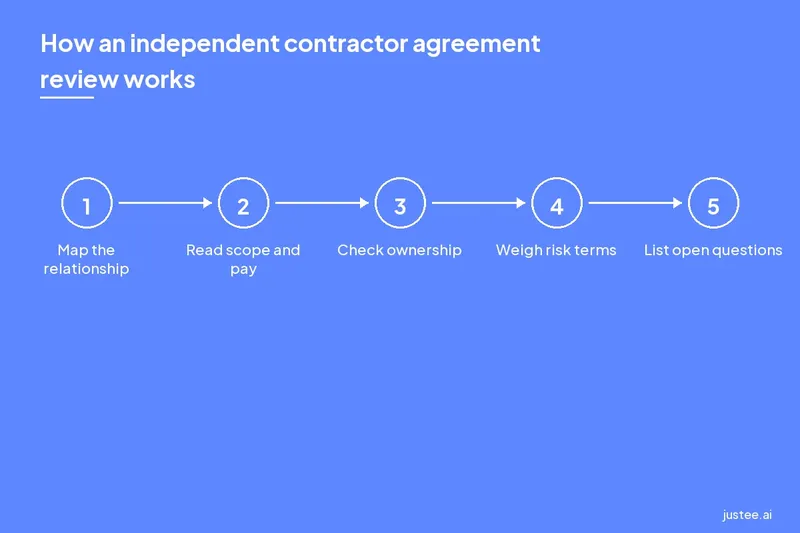
That gives a review two jobs. The first is to read the agreement as a contract: is the scope clear, is the price clear, who owns the work, and what happens if something goes wrong. The second is to compare the document with reality: does the agreement describe how this person will actually work, or does it describe an arrangement that exists only on paper?
A few related documents often travel with the main contract:
- Statement of work. Many agreements put the scope, milestones and fees in a separate statement of work, so the main contract can be reused across projects.
- Confidentiality agreement. Some businesses use a stand-alone NDA instead of, or in addition to, a confidentiality clause.
- IP assignment. Some companies have contractors sign a separate invention assignment agreement or a PIIA.
- Tax forms. The hiring business usually collects an IRS Form W-9 so it can report payments.
Justee is designed to help a business owner or a contractor read an independent contractor agreement clause by clause; deciding how a working relationship should be classified stays with the parties and their lawyers.
How the IRS, the Department of Labor and the states classify workers
There is no single federal definition of an independent contractor. Different laws use different tests, and the same worker can, in principle, be treated differently under each. A short map helps before reading the clauses.
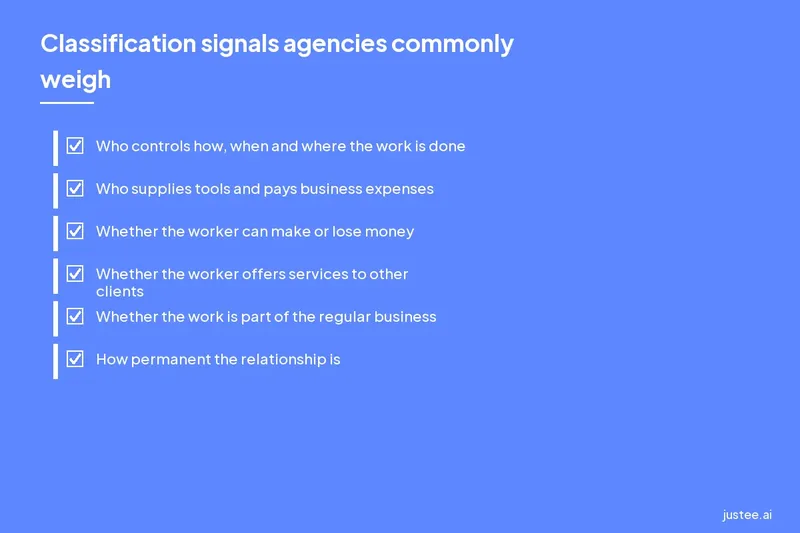
The IRS common-law test. For federal employment taxes, the IRS applies the common-law rules described on its page about the common-law employee. Evidence falls into three categories: behavioral control (whether the business controls or has the right to control what the worker does and how they do it), financial control (who pays expenses, whether the worker can make or lose money, and whether they offer services to the market), and the relationship of the parties (written contracts, benefits, permanence, and whether the work is a key part of the regular business). No single factor decides the outcome. When the answer is unclear, either the business or the worker can ask the IRS for a determination on Form SS-8.
The Fair Labor Standards Act. For minimum wage and overtime, the Department of Labor and the courts ask whether the worker is economically dependent on the business or is in business for themselves. The Department published a rule in 2024 that set out six factors to weigh in the totality of the circumstances. In May 2025, its Wage and Hour Division issued Field Assistance Bulletin 2025-1, which said it would no longer apply the 2024 rule's analysis in its own enforcement and would rely on earlier guidance while it reconsidered the rule; the bulletin noted that the 2024 rule still governed private lawsuits. Federal policy on this question has changed several times, so it is worth checking the Department's site for the current position before relying on any summary, including this one.
State tests. States set their own rules for state wage laws, unemployment insurance and workers' compensation, and some are stricter than the federal tests. California's ABC test, adopted by statute after the state Supreme Court's 2018 Dynamex decision and now found in Labor Code section 2775, presumes a worker is an employee unless the hiring entity shows three things: the worker is free from its control and direction, the work is outside the usual course of its business, and the worker is customarily engaged in an independently established trade or business of that kind. The state's ABC test overview explains the elements and the occupational exemptions. Other states use ABC-style tests for some purposes too, which is why both the state named in the governing-law clause and the state where the work is done matter.
The U.S. Small Business Administration's guide to hiring and managing employees is a plain-language starting point for business owners weighing whether to bring someone on as an employee or a contractor. The agreement cannot settle these questions on its own, but its wording can either support the intended classification or undercut it.
Terms 1 to 4: scope, control, payment and expenses
The commercial heart of the agreement is in the first four terms. They are also where the document most often reveals whether the relationship looks like a contract for services or a job.
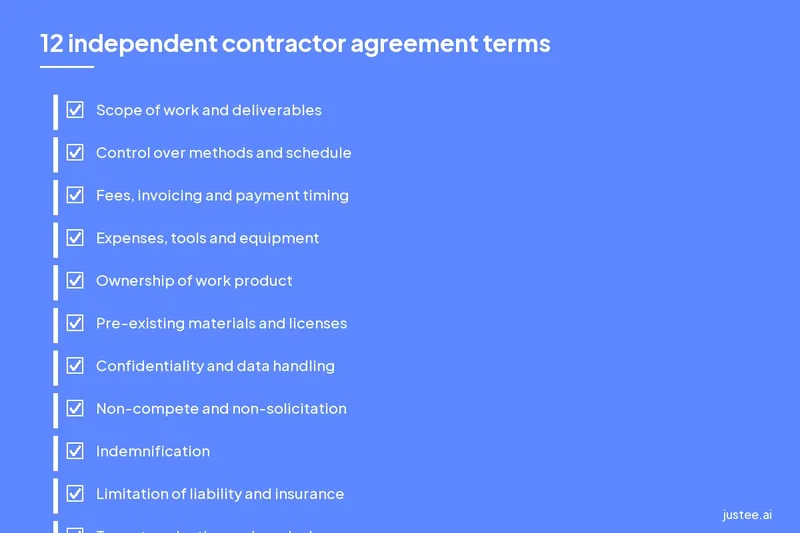
1. Scope of work and deliverables
A clear scope describes a result: a website, a set of designs, a marketing campaign, or a defined block of consulting time on a defined problem. Scope language that reads like a job description, such as a list of ongoing responsibilities or a catch-all for other duties as assigned, can make the arrangement harder to distinguish from employment and makes disputes about extra work more likely. Reviewers commonly look for acceptance criteria (how the business confirms a deliverable is done), a change-order process for work outside the original scope, and whether the scope sits in the main agreement or in a separate statement of work that can be updated.
2. Control over methods, schedule and location
Independent contractors typically decide how, when and where they do the work, within agreed deadlines and specifications. Clauses that set fixed working hours, require attendance at internal meetings unrelated to the project, impose company training, or place the contractor under a manager's day-to-day supervision line up with the behavioral-control factors described above. Many agreements state expressly that the contractor controls the manner and means of the work. That sentence carries more weight when the rest of the document, and the actual working arrangement, are consistent with it.
3. Fees, invoicing and payment timing
The fee clause should answer four questions: how the fee is calculated (fixed price, hourly or daily rate, milestones or a retainer), when invoices are sent, when they are due, and what happens if payment is late. Contractors often ask for a deposit on larger projects and for late-payment interest; businesses often ask for the right to withhold payment for disputed work. Because a contractor is not on payroll, the business generally does not withhold income or employment taxes and instead reports payments to the IRS on an information return, while the contractor handles their own self-employment tax. Some states and cities also have freelance payment laws. New York State and New York City, for example, have laws that require written contracts and timely payment for many freelance engagements, so the place where the work is done can add requirements a template does not mention.
4. Expenses, tools and equipment
Who pays for software licenses, travel, materials and equipment is both a money question and a classification signal. Under the IRS financial-control category, a worker who invests in their own tools, pays their own business expenses and can make or lose money on a project looks more like an independent business. An agreement that has the company supply a laptop, reimburse every expense and pay by the hour with no possibility of profit or loss is not necessarily wrong, but it is worth reading alongside the classification factors. Reviewers also check whether reimbursable expenses need prior approval and whether they can be marked up.
Read your independent contractor agreement clause by clause
Upload a PDF or DOCX, or paste the text. Justee identifies clauses and rates findings Critical, Moderate or Note, typically in 1 to 6 minutes.
Review a contractor agreementNo credit card requiredResults in minutesAES-256 encryption
Terms 5 to 7: who owns the work, licenses and confidentiality
For many small businesses and startups, the most important question in an independent contractor agreement is who owns what the contractor creates. Founders are often surprised by the answer U.S. copyright law gives when the contract is silent or unclear.
5. Ownership of work product
Under the definition of a work made for hire in 17 U.S.C. section 101, work created by an employee within the scope of employment belongs to the employer. Work created by an independent contractor is a work made for hire only if two conditions are both met: it falls into one of nine categories listed in the statute (such as a contribution to a collective work, part of a motion picture or other audiovisual work, a translation, a compilation, an instructional text, a test, or an atlas), and the parties sign a written agreement saying it is a work made for hire. The U.S. Copyright Office explains these rules in Circular 30, Works Made for Hire. In Community for Creative Non-Violence v. Reid (1989), the Supreme Court held that general agency-law factors decide whether a creator is an employee for this purpose, so the label in the contract is not the end of the analysis.
Software code, logos and many marketing materials do not fit neatly into the nine categories. That is why many agreements pair work-made-for-hire language with a present assignment of rights, so that ownership transfers to the business even if the work-for-hire label does not apply. Copyright transfers generally need a signed writing. A review typically checks what is assigned (copyright only, or patents, trademarks and trade secrets too), when the assignment takes effect, and whether the contractor keeps any right to show the work in a portfolio.
Illustrative example; have a lawyer adapt any clause to your contract and state. “Contractor hereby assigns to Company all right, title and interest in and to the Deliverables, including all intellectual property rights in them, effective upon Company's payment of the fees for those Deliverables.”
Some agreements tie the assignment to payment, as in that example, which contractors commonly ask for; others make it effective on creation, which businesses commonly prefer. California adds a wrinkle: its Labor Code section 3351.5(c) and Unemployment Insurance Code section 686 treat a person who commissions a work made for hire under a written agreement as an employer for certain workers' compensation and unemployment insurance purposes. How that applies to a particular contract is a question for a California lawyer. Ownership can also be handled in a separate document; the work-for-hire agreement review covers that format.
6. Pre-existing materials and licenses back
Contractors usually bring their own tools, code libraries, templates and know-how to a project. A well-drafted agreement separates those pre-existing materials from the new deliverables: the contractor keeps ownership of what they brought, and the business receives a license to use whatever is built into the deliverables. Points that commonly come up include whether the license is perpetual, whether it can be transferred if the business is sold, and whether the deliverables include open-source components with their own license terms.
7. Confidentiality and data handling
The confidentiality clause defines what information is confidential, how long the obligation lasts, the usual exceptions (information that is public or that the contractor already knew), and what happens to materials when the work ends. If the contractor will see customer records, employee files or other personal data, reviewers also look for data-handling terms covering security, limits on use and what happens to the data after the project. Before sharing documents that contain personal information with any outside party or AI tool, some businesses remove what is not needed; the PII redaction tool is one way to do that for PDF and DOCX files.
Terms 8 to 10: restrictive covenants, indemnification, liability and insurance
8. Non-compete and non-solicitation clauses
Some contractor templates borrow restrictive covenants from employment agreements. A broad non-compete in a contractor agreement can sit awkwardly with the idea that the contractor runs an independent business serving other clients, which is itself one of the classification factors. The Federal Trade Commission's 2024 non-compete rule was set aside by a federal court before it took effect, so enforceability is still governed by state law, and states differ widely. California's Business and Professions Code section 16600 voids most non-compete agreements, and several other states restrict them for some workers or income levels. A narrower non-solicitation clause, limited to soliciting the business's clients or staff during the engagement and for a defined period after, is common. A broad covenant may be unenforceable in some states; whether a particular clause is enforceable against a particular person is a question for a lawyer. The non-compete agreement review page covers these clauses in more depth.
9. Indemnification
An indemnification clause decides who pays if a third party brings a claim. Typical examples are claims that a deliverable infringes someone else's intellectual property, claims for injury or property damage caused by the contractor, and claims arising from the contractor's own employees or subcontractors. Some business templates also ask the contractor to cover taxes, penalties or benefits claims if the worker is later reclassified as an employee. Points commonly discussed include whether the indemnity runs both ways, whether it is limited to claims caused by the indemnifying party's own breach or negligence, and how it interacts with the liability cap.
10. Limitation of liability and insurance
A limitation of liability clause caps how much either party can recover, often by reference to the fees paid under the agreement, and usually excludes indirect or consequential damages. Many caps carve out certain claims, such as breaches of confidentiality, indemnification obligations or intellectual property infringement. The guide to the limitation of liability clause explains how caps and carve-outs work together. Insurance clauses may ask the contractor to carry general liability, professional liability (errors and omissions) or, for contractors with their own staff, workers' compensation coverage, and to name the business as an additional insured. Reviewers check whether the required coverage is realistic for the size of the engagement and whether certificates of insurance are required before work starts.
Reading an independent contractor agreement yourself vs. AI-assisted review
| Review step | Reading it yourself | AI-assisted review |
|---|---|---|
| First pass through the clauses | Line by line, at your own pace | Clauses identified; findings rated Critical, Moderate or Note |
| Finding the ownership terms | Search for assignment and work made for hire language | Ownership clauses flagged for a closer read |
| Checking state rules | Look up the statutes yourself | Reference library of U.S. and England & Wales legislation; any U.S. state can be selected |
| Comparing two drafts | Read both versions side by side | Justee Document Comparison lists insertions, deletions, replacements and visual changes |
| Deciding classification | Depends on facts outside the document | Depends on facts outside the document; the AI reads only the text |
| When to talk to a lawyer | For advice on any contract, routine or not | For advice on any contract, routine or not |
* AI-assisted review provides legal information, not legal advice. It reads the text of the document and cannot see how the work is actually performed. Justee Document Comparison is rule-based and does not use AI or explain what a change means.
Terms 11 and 12: term, termination and dispute resolution
11. Term, termination and what survives
Contractor engagements usually have an end: a project completion date, a fixed term, or a right for either party to terminate on written notice. An arrangement with no end date, renewed indefinitely, in which the contractor works only for one business, can look more like employment under the relationship-of-the-parties factors. Termination clauses typically cover notice periods, termination for breach and any chance to cure it, payment for work completed and accepted before termination, return of confidential materials and handover of work in progress. A survival clause lists the terms that continue after the contract ends, such as confidentiality, ownership, indemnification and payment obligations. If the agreement renews automatically, the guide to the automatic renewal clause explains what to look for.
12. Governing law, venue and arbitration
The governing-law clause picks which state's contract law applies, and the venue clause picks where disputes are heard. Neither clause necessarily controls which state's worker-classification or wage laws apply; those often depend on where the work is performed. Many agreements require arbitration and waive class or collective actions. The Federal Arbitration Act generally supports enforcing arbitration agreements, but section 1 exempts contracts of employment of transportation workers, and in New Prime Inc. v. Oliveira (2019) the Supreme Court held that this exemption reaches independent contractor agreements with transportation workers as well. Reviewers also look at who pays arbitration fees, where the arbitration takes place and whether small claims court remains available.
How AI-assisted review fits into an independent contractor agreement review
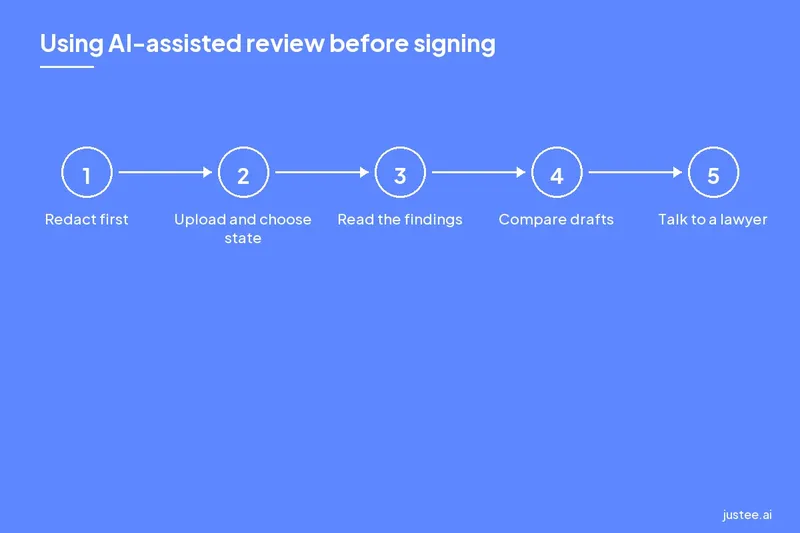
Justee is designed for the first part of an independent contractor agreement review: reading the document as a contract, finding each of the twelve terms above, and turning a dense template into a list of questions. It cannot do the second part on its own, because classification depends on how the work is actually done, and that is not in the document. A practical workflow looks like this.
- Remove personal data that does not need to be shared. According to Justee, the Justee PII Redaction Tool detects names, organizations, addresses, contact details, dates of birth, and government and financial ID numbers on a best-effort basis, for PDF and DOCX files. Redaction reduces how much personal data reaches the AI model; it does not by itself make a workflow compliant with any privacy law.
- Upload the agreement and choose the state. According to Justee, the contract review accepts a PDF or DOCX, including scanned PDFs, or pasted text, and any U.S. state can be selected; the free trial covers one jurisdiction per document and paid plans up to two.
- Read the findings. According to Justee, a review typically takes 1 to 6 minutes, and each finding is rated Critical, Moderate or Note. The analysis draws on a reference library of over 1 million sections of U.S. and England & Wales legislation.
- Compare drafts. When the other side sends a revised version, Justee Document Comparison lists the changes between two files (PDF, DOCX or TXT) by type: insertion, deletion, replacement or visual change. It is rule-based, does not use AI, and does not explain what a change means, so the meaning of each change is still a question for the reader and their lawyer.
- Ask general questions. Justee Legal AI Chat gives general legal information, for example about what a work made for hire is; it does not draft letters or filings for anyone's matter.
- Bring the list to a lawyer. The output is a set of flagged clauses and questions to discuss, not a decision about the contract.
For founders signing several contractor agreements at once, the startup contract review page shows how the same workflow applies to other early-stage documents, and the general contract review checklist covers clauses that appear in almost every agreement. Contractors reviewing a client's template may also want the list of freelance contract red flags.
On privacy, documents are processed on Justee's servers, which are hosted on AWS, and data is encrypted in transit (TLS 1.2+) and at rest (AES-256). Full Private Mode is optional on paid plans: Justee's servers process the document, then seal the result with a key only the user holds, and it covers only the items made with it on. The Private Mode page explains the details. Prices run from $16/month to $149/month, billed annually (monthly billing costs more), and free use has page, state and usage limits.
Justee aims to make an independent contractor agreement easier to read and easier to discuss with a lawyer; it assists judgment and does not replace it.
“In my view, the independent contractor agreement is one of the most misunderstood documents a small business signs. People tend to expect the label on the first page to settle the relationship, and it does not. What the document can do well is make the practical terms clear: what the work is, what it costs, who owns the result and how either side can walk away. Those are the parts I think deserve the slowest read.”
Classification depends on how the work is done day to day, which no document review can observe. A clear agreement still matters, because disputes over ownership, payment and termination usually turn on what the contract actually says, and a business and a contractor who read it closely at the start tend to have fewer surprises later.
Frequently Asked Questions
Does signing an independent contractor agreement make someone an independent contractor?
No. The agreement is evidence of what the parties intended, but the IRS, the U.S. Department of Labor and state agencies each look at how the work is actually performed, including who controls the work, who bears expenses and how permanent the relationship is. An agreement that does not match the real arrangement may not hold up. An employment lawyer can advise on a specific relationship.
Who owns the work an independent contractor creates?
Under U.S. copyright law, a contractor generally owns the copyright in what they create unless the work fits one of nine statutory work-made-for-hire categories and both parties signed a written agreement saying so, or the contractor assigned the rights in a signed writing. Many agreements include both work-made-for-hire language and an assignment for that reason. A lawyer can explain how this applies to a particular contract.
Can an independent contractor agreement include a non-compete?
Some do, but enforceability depends on state law. The FTC's 2024 non-compete rule was set aside before it took effect, California voids most non-competes, and other states restrict them in various ways. A broad non-compete can also sit uneasily with contractor status. Whether a particular clause is enforceable against a particular person is a question for a lawyer.
Is an independent contractor agreement the same as a consulting agreement?
They overlap. A consulting agreement is usually a type of independent contractor agreement for advisory or professional services, while the broader term also covers creative, technical and trade work. The key clauses, such as scope, fees, ownership, confidentiality, liability and termination, are much the same.
Can AI review an independent contractor agreement?
AI-assisted review can read the text, identify the clauses discussed in this guide and flag terms to understand. According to Justee, its review rates findings Critical, Moderate or Note. AI cannot see how the work is actually done, so it cannot decide how a worker should be classified, and its output is legal information, not legal advice.
When is it worth talking to a lawyer about an independent contractor agreement?
For advice on any contract, routine or not, talk to a lawyer. That includes questions about classification, ownership of work, restrictive covenants and what a clause means for a specific business or contractor. An AI review can help organize those questions before the conversation.
Understand the terms before you sign
Start with a free review of your independent contractor agreement (free use has page, state and usage limits). Paid plans run from $16/month to $149/month, billed annually (monthly billing costs more).
Start a reviewAn independent contractor agreement works best when it describes the relationship as it really is and leaves no doubt about the work, the price, who owns the result and how the engagement ends. Reading the twelve terms above, and comparing them with how the work will actually be done, is a way to understand the terms before you sign. Justee can help with the reading of an independent contractor agreement; the judgment stays with the people signing and their lawyers. It is not a substitute for the advice of an attorney; for advice on any contract, routine or not, talk to a lawyer.
Max Zaykov is the founder of Justee.ai, an AI tool that helps people understand their legal documents.
Justee is not a law firm. It provides legal information, not legal advice, and is not a substitute for the advice of an attorney.