Law
Corporate Bylaws Review: The Provisions Founders Should Understand Before Adopting Them

Key Takeaways
- Corporate bylaws are a corporation’s internal operating rules; they sit below state law and the certificate (or articles) of incorporation, which control if the documents conflict.
- The provisions that most often matter later are board size and vacancies, officer authority, meeting notice and quorum, written consent, transfer restrictions, indemnification and the amendment clause.
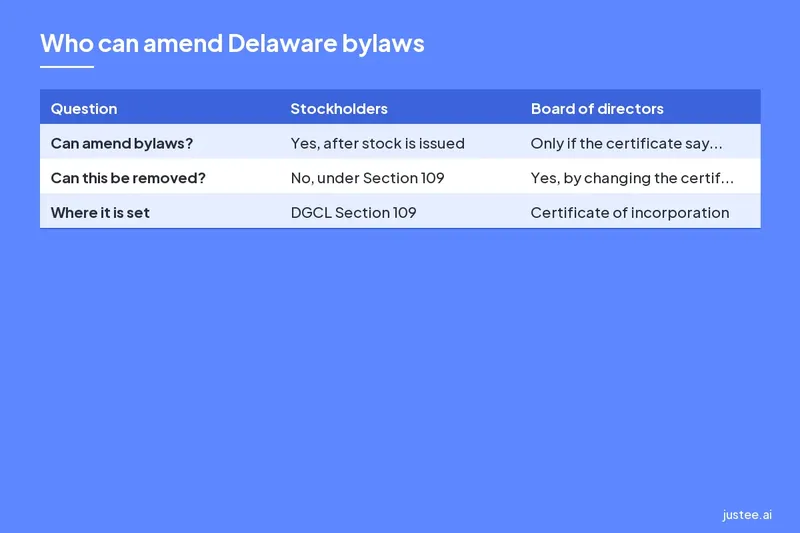
- In Delaware, stockholders always keep the power to amend the bylaws; the board shares that power only if the certificate of incorporation grants it.
- Template bylaws are common at formation and are often revisited before a priced financing round or a new board seat.
- AI-assisted review can flag provisions to discuss; it is not a substitute for advice from a corporate lawyer.
Corporate bylaws are the internal rulebook of a corporation: they set out how the board of directors is elected and runs its meetings, what the officers can do, how stockholders vote, and how the rules themselves can be changed. Most founders adopt them on the day the company is formed, often from a template, and do not read them closely again until something forces the issue: a co-founder leaves, an investor asks for a board seat, a lawyer for the other side of a financing starts diligence, or two directors disagree about whether a meeting was valid.
This guide walks through a typical set of bylaws provision by provision. It explains what each provision does, how Delaware law (the most common home for venture-backed startups) and other state corporate statutes shape it, and the questions founders and investors commonly raise. It also shows where a tool such as the Justee corporate bylaws review fits in, and where the work belongs with a corporate lawyer. It is legal information for understanding the document, not legal advice about any company’s governance.
Corporate bylaws are the internal governing rules a corporation adopts to run its affairs, covering the board of directors, officers, stockholder meetings and voting, stock records, indemnification and amendments. They rank below the state corporation statute and the certificate or articles of incorporation, so a bylaw that conflicts with either is generally ineffective. Under Section 109 of the Delaware General Corporation Law, bylaws may contain any provision relating to the business of the corporation and the rights and powers of its stockholders, directors, officers and employees, as long as it is not inconsistent with law or the certificate of incorporation. Bylaws are usually not filed with the state, which makes them easy to adopt from a template and easy to forget. A careful corporate bylaws review checks whether the document matches the certificate, the company’s stockholder agreements and how the board actually operates. A corporate lawyer is the right person to advise on any specific provision.
What corporate bylaws do, and how they fit with the other governing documents
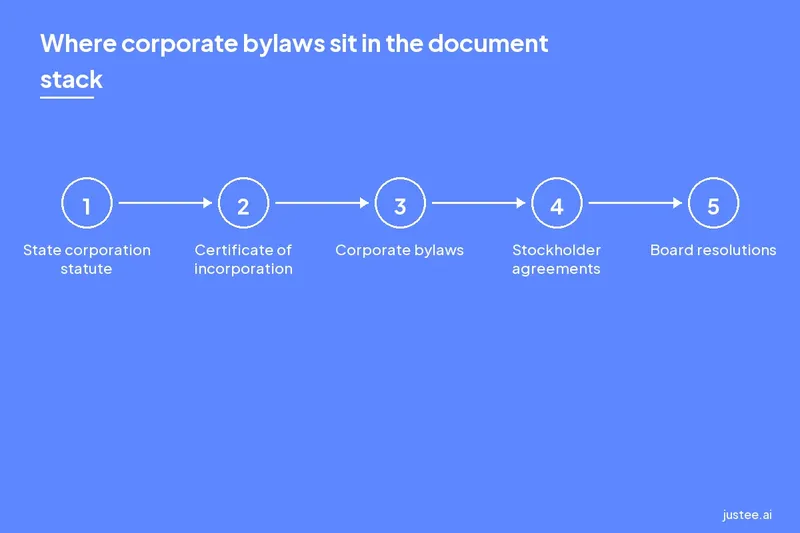
A corporation is governed by a stack of documents, and the order matters. At the top is the state corporation statute, such as the Delaware General Corporation Law or the corporations code of the state where the company is incorporated. Next is the certificate of incorporation (called the articles of incorporation in many states), which is filed with the state; the Delaware Division of Corporations handles those filings for Delaware companies. Below that sit the bylaws, and alongside them any stockholder agreements, such as voting agreements, investor rights agreements or a shareholder agreement.
The U.S. Small Business Administration’s guide to choosing a business structure explains why the corporate form comes with more formalities than an LLC, and the bylaws are where most of those formalities are written down. Cornell Law School’s Legal Information Institute defines bylaws as the rules a corporation adopts for its internal governance, and that is a useful frame: bylaws rarely decide who owns what, but they decide how decisions get made.
Founders sometimes treat the bylaws as interchangeable with other documents. A few distinctions help:
- Bylaws vs. certificate of incorporation. The certificate sets the authorized shares, classes of stock and certain protections that state law only allows in the certificate. The bylaws handle procedure. The articles of incorporation generally control in a conflict.
- Bylaws vs. LLC operating agreement. An LLC has an operating agreement instead of bylaws; the guide to LLC operating agreement review covers that document.
- Bylaws vs. founders agreement. Equity splits, vesting and IP assignment usually live in a founders agreement or stock purchase agreements, not in the bylaws.
Most states model their corporate statutes in part on the American Bar Association’s Model Business Corporation Act, while Delaware has its own statute. The provisions below use Delaware as the main example because it is a common choice for startups; the same topics appear in other states, with different default rules.
Justee is designed to make a corporate bylaws review easier to start and easier to follow; deciding how a company should be governed stays with its founders, board and lawyer.
The board of directors: size, elections, vacancies, quorum and written consent
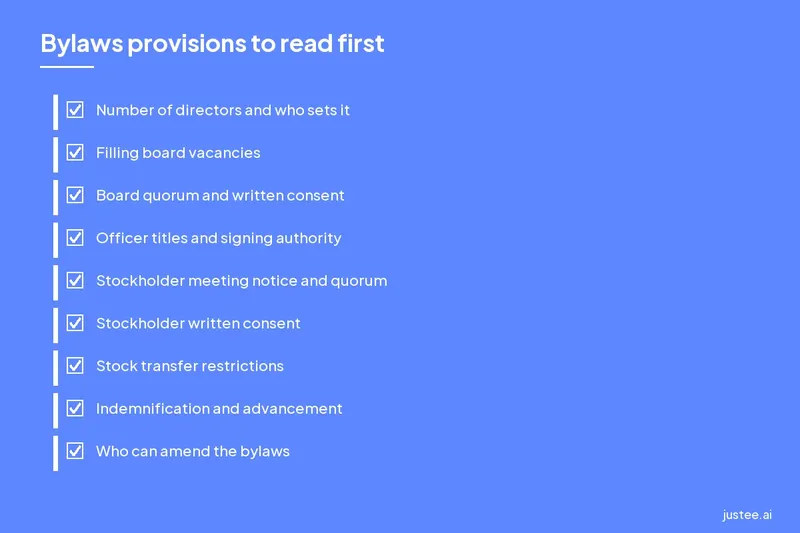
The board section is usually the longest and most consequential part of the bylaws. Under Section 141 of the Delaware General Corporation Law, the business of a corporation is managed by or under the direction of its board, and the number of directors is fixed by or in the manner provided in the bylaws unless the certificate of incorporation fixes it. That makes the board-size clause a quiet source of leverage: if the bylaws let the board change its own size by resolution, the board can add seats without a stockholder vote.
Points that commonly come up in a review of the board section:
- Number of directors. Whether the number is a fixed figure, a range, or set by board resolution, and whether a financing agreement already promises investors a particular board composition.
- Election and term. Whether directors are elected annually or in staggered classes. In Delaware, a classified board generally has to be set up in the certificate or an initial or stockholder-adopted bylaw.
- Removal. Delaware law generally allows a majority of stockholders to remove directors with or without cause, with exceptions for classified boards and cumulative voting. Bylaw language that seems to limit removal may not change that statutory rule.
- Vacancies. Whether the remaining directors can fill a vacancy or a new seat, or whether stockholders decide. This matters most when a founder-director leaves.
- Quorum and voting. Delaware’s default board quorum is a majority of the total number of directors; the certificate or bylaws can require more, and the bylaws can set a lower number, but not below one-third.
- Action without a meeting. Section 141(f) lets the board act by unanimous written or electronic consent unless the certificate or bylaws restrict it. Early-stage boards rely on this constantly, so a restriction here can slow ordinary decisions.
- Committees. Whether the board can form committees, such as compensation or audit committees, and what they can decide alone.
Board decisions made under these procedures are also what courts examine when they apply the business judgment rule, which generally presumes directors acted on an informed basis and in good faith. Clean procedure does not decide whether a decision was a good one, but disputes often turn on whether a meeting was properly called, noticed and attended.
Officers: titles, authority and who can sign
Under Section 142 of the Delaware statute, a corporation has the officers stated in its bylaws or in board resolutions consistent with the bylaws, and each officer holds the title and duties those documents give them. Template bylaws usually name a president or chief executive officer, a secretary and a treasurer or chief financial officer, and allow the board to appoint others.
The officer section answers questions that come up in daily operations more often than founders expect:
- Signing authority. Which officers can sign contracts, checks and stock certificates, and whether any categories of contracts need board approval first. Counterparties and banks often ask for this.
- Appointment and removal. Whether officers serve at the pleasure of the board. Removal from an office is a governance question; any employment rights the person has are governed separately, for example by an offer letter or employment agreement.
- One person, several offices. Delaware allows one person to hold more than one office unless the certificate or bylaws say otherwise, which is common in a company with one or two founders.
- Overlap with the board. Bylaws sometimes give the chief executive officer powers that overlap with the board’s, which can create confusion when the CEO and the board disagree.
The secretary’s duties deserve a careful read too. The secretary usually keeps minutes, the stock ledger and the corporate records, and those records are what investors, acquirers and auditors ask for in diligence. A founder who has never held a formal board meeting may find that the bylaws describe a process the company has not followed, which is a common item to clean up before a financing.
Stockholder meetings: annual meetings, notice, quorum, voting and written consent
Delaware’s rules for stockholder meetings sit in Subchapter VII of the Delaware General Corporation Law, and the bylaws fill in the details the statute leaves open. The key provisions are these.
Annual meeting. Section 211 calls for an annual meeting to elect directors on a date set by or under the bylaws. If no annual meeting or written-consent election of directors has taken place for 13 months, the Court of Chancery may order one on the application of a stockholder or director. Many private companies elect directors by written consent instead of holding a meeting, which the bylaws and the statute generally allow.
Notice. Section 222 generally requires written notice of a stockholder meeting not less than 10 nor more than 60 days before the meeting date. The bylaws usually describe how notice is given, including electronic notice, and how a stockholder can waive it.
Quorum. Under Section 216, the certificate or bylaws can set the quorum for a stockholder meeting, but not below one-third of the shares entitled to vote; if they are silent, a majority of those shares is the quorum. A bylaw quorum set very high can make it hard to act at all.
Voting standard. Whether directors are elected by a plurality (the most votes wins) or a majority of votes cast, and what vote is needed for other matters. Investor protective provisions, which require a separate vote of preferred stockholders for certain actions, normally sit in the certificate rather than the bylaws.
Written consent of stockholders. Section 228 allows stockholders to act by written consent, without a meeting, unless the certificate of incorporation provides otherwise. Private companies use this heavily. A reviewer checks that the bylaws describe the consent process consistently with the statute.
Special meetings and advance notice. Who can call a special meeting, and whether stockholders have to give advance notice of nominations or proposals. Advance-notice bylaws are routine in public companies and less common, but not unheard of, in private ones.
Other states have their own versions of these rules. California’s Corporations Code addresses bylaw content in Section 212, and New York’s Business Corporation Law addresses bylaws in Section 601. A company incorporated outside Delaware needs its bylaws read against its own state’s statute.
Read your corporate bylaws provision by provision
Upload a PDF or DOCX, or paste the text. Justee identifies clauses and rates findings Critical, Moderate or Note, typically in 1 to 6 minutes.
Review bylawsNo credit card requiredResults in minutesAES-256 encryption
Stock, transfer restrictions and corporate records
Bylaws usually include a section on stock: whether shares are certificated or uncertificated, how transfers are recorded on the stock ledger, and how lost certificates are replaced. In many startup bylaws, this section also contains a transfer restriction, often a company right of first refusal on any proposed sale of common stock.
Section 202 of the Delaware statute allows restrictions on the transfer of shares to be imposed by the certificate, the bylaws or an agreement, and makes them enforceable against a holder who had notice of them, including through a conspicuous notation on the certificate or the notice sent for uncertificated shares. A reviewer commonly looks at three questions here:
- Does the bylaw restriction apply to all stock or only to common stock, and does it exempt transfers to family trusts or affiliates?
- Does it duplicate, or conflict with, a right of first refusal in a separate stockholder agreement or in a buy-sell agreement?
- Were the required legends or notices actually placed on the company’s stock records?
The records section is the other half. Bylaws often say where the stock ledger and minutes are kept and how stockholders can request them. In Delaware, a stockholder’s right to inspect books and records comes from Section 220 of the statute, so bylaws generally cannot take it away, although they can describe the process. Companies that issue stock subject to vesting should also confirm that the vesting terms in each vesting agreement or stock purchase agreement line up with the transfer provisions in the bylaws.
Other provisions in this part of a typical set of bylaws include the fiscal year, how a corporate seal is used (if at all), and an emergency bylaw that applies if a catastrophe makes it impossible to convene a quorum. These are rarely controversial, but a template copied from another company sometimes carries over a fiscal year or office address that no longer fits.
Indemnification, advancement, forum selection and amendments
Indemnification and advancement. Section 145 of the Delaware statute allows a corporation to indemnify directors, officers, employees and agents for expenses and losses from proceedings connected to their role, subject to conditions such as acting in good faith, and requires indemnification of a present or former director or officer who succeeds on the merits or otherwise in defending a covered proceeding. Many bylaws go further and make indemnification mandatory to the fullest extent the law allows, and promise advancement of legal fees while a case is pending. Advancement is often the provision that matters most in practice, because it decides who pays the lawyers before anyone knows the outcome. Directors appointed by investors often also have separate indemnification agreements, and a reviewer checks whether those agreements and the bylaws fit together.
Exculpation is in the certificate, not the bylaws. Section 102(b)(7) lets the certificate of incorporation limit the personal monetary liability of directors, and since 2022 certain officers, for breaches of the duty of care. Founders sometimes assume this protection appears in the bylaws; it only works if it is in the certificate.
Forum selection. Under Section 115, the certificate or bylaws may require internal corporate claims, such as fiduciary duty claims, to be brought in Delaware courts, but may not prohibit bringing them in Delaware. Delaware law also generally prohibits bylaws that shift litigation fees onto stockholders.
Amendments. Under Section 109, once a corporation has received payment for its stock, the power to adopt, amend or repeal bylaws belongs to the stockholders, and the certificate of incorporation can also give that power to the board. Granting it to the board does not take it away from the stockholders. The amendment clause therefore answers a practical question: can the board change its own rules without asking anyone? Investors commonly look at whether certain bylaw provisions, such as board size, can be amended only with a stockholder or investor vote.
Nonprofit corporations have bylaws too, and their content is shaped by state nonprofit law and by tax-exemption requirements; the IRS application for recognition of exemption, Form 1023, asks about an organization’s bylaws. The provisions in this guide focus on for-profit corporations, and a nonprofit’s bylaws are a separate review.
How an AI-assisted corporate bylaws review works with Justee
A corporate bylaws review with Justee starts with uploading the bylaws as a PDF or DOCX file (scanned PDFs work) or pasting the text, then selecting the state whose law should apply, usually the state of incorporation. Any U.S. state can be selected; the free trial allows one jurisdiction per document and paid plans allow up to two, which can help when a Delaware corporation is headquartered in another state. The review checks the document against a reference library of over 1 million sections of U.S. and England & Wales legislation.
According to Justee, reviews typically take 1 to 6 minutes. According to Justee, findings are rated Critical, Moderate or Note, so a reader can start with the provisions most likely to need a conversation. From there, Justee Legal AI Chat can answer general legal questions about a highlighted clause, such as what a board quorum provision means when a seat is vacant, and any edit it proposes lands in the document as a tracked change the user can accept or reject. The chat gives general legal information; it does not draft resolutions, letters or filings for a specific matter.
Bylaws are usually amended rather than replaced, often as part of a financing. Justee Document Comparison accepts PDF, DOCX and TXT files and lists the changes between the old and amended version by type: insertions, deletions, replacements and visual changes. It is rule-based, does not use AI, and does not explain what a change means; that interpretation is what the review and the conversation with a lawyer are for. The document comparison page explains each change type.
On privacy, according to Justee, personal and business identifiers are redacted on a best-effort basis before document text reaches an AI model. Documents are processed on Justee’s servers, hosted on AWS, and encrypted in transit (TLS 1.2+) and at rest (AES-256). Files uploaded without an account are deleted after 24 hours, and reviews in an account are kept until the user deletes them. Optional Full Private Mode, available on paid plans, seals the result with a key only the user holds, for the items made with it on. For documents such as a cap table export or signed consents that contain personal details, the Justee PII Redaction Tool accepts PDF and DOCX files and replaces detected names, addresses, contact details and ID numbers in minutes; it does not detect amounts. The privacy FAQ has the details, and pricing runs from $16/month to $149/month, billed annually (monthly billing costs more); free use has page, state and usage limits.
Justee is designed to show where a governing document may need attention and to explain it in plain English; it does not decide how a company should be run.
Founders working through formation documents often read this alongside the guides to founders agreement review and share purchase agreement review. Legal AI Chat can also answer general questions about corporate law in a chosen state, and the full list of supported document types is on the contract review page.
Corporate bylaws review: reading it yourself vs AI-assisted review
| Task | Reading it yourself | AI-assisted review (Justee) |
|---|---|---|
| Finding every provision | Page-by-page reading of a dense template | Clauses identified, findings rated Critical, Moderate or Note |
| Checking state law | Reading the statute section by section | Checked for the state selected (up to two on paid plans) |
| Understanding a term | Look it up or ask a colleague | Ask Justee Legal AI Chat for general legal information |
| Tracking amendments | Manual side-by-side reading | Justee Document Comparison lists insertions, deletions, replacements and visual changes |
| Time to a first read | Depends on length and familiarity | Typically 1 to 6 minutes per review |
| When to talk to a lawyer | Before adopting or amending the bylaws | Before adopting or amending the bylaws |
* Justee output is legal information, not legal advice. AI-assisted review is designed to help readers understand corporate bylaws; it can miss issues and is not a substitute for the advice of a corporate lawyer. Feature details as of November 2026.
“In my view, bylaws are the most underestimated document a founder signs. They feel like boilerplate on formation day, and then the first real disagreement on the board turns on a sentence about quorum or vacancies that nobody read. AI review is useful here because it makes a dense, procedural document quick to scan for the provisions worth a conversation, and that conversation belongs with a corporate lawyer.”
Justee is designed to surface governance provisions that may need attention and to explain them in plain English. Deciding how a company should be governed, and how a provision applies to a particular situation, is a judgment for the founders, the board and their lawyer.
Frequently Asked Questions
Are corporate bylaws legally required?
State corporation statutes generally expect a corporation to adopt bylaws, and in practice banks, investors and acquirers ask for them. Bylaws are usually not filed with the state; they are adopted by the incorporator or the initial board and kept with the corporate records. Whether a particular company’s bylaws meet its state’s requirements is a question for a corporate lawyer.
What is the difference between bylaws and the certificate of incorporation?
The certificate of incorporation, called the articles of incorporation in many states, is filed with the state and sets basic terms such as authorized shares and classes of stock. Bylaws are internal and set procedure: board size and meetings, officers, stockholder voting and amendments. If the two conflict, the certificate generally controls, and some protections, such as director exculpation in Delaware, only work if they are in the certificate.
Who can amend corporate bylaws?
It depends on the state and the governing documents. In Delaware, once stock has been issued, stockholders hold the power to amend the bylaws, and the certificate of incorporation can also give that power to the board without taking it away from stockholders. Bylaws or stockholder agreements sometimes require a particular vote for certain amendments. Who can approve a specific amendment at a specific company is a question for a lawyer.
Can AI review corporate bylaws?
AI can help with the reading. Justee can review corporate bylaws, identify clauses, check them against the law of the selected state, and rate findings Critical, Moderate or Note, typically in 1 to 6 minutes. It can miss issues, and it does not know how a board actually operates or what side agreements exist. Its output is legal information, not legal advice, and it is not a substitute for a corporate lawyer before bylaws are adopted or amended.
Do bylaws change when a startup raises money?
They often do. A priced financing round commonly comes with an amended certificate of incorporation and sometimes amended bylaws, for example to change board size or how vacancies are filled, and with separate voting and investor rights agreements. Comparing the old and new versions line by line, then reading the changes with a lawyer, is a common way founders track what moved.
Is it safe to upload corporate bylaws to an AI tool?
It depends on the tool’s data practices, which are worth reading before uploading any internal document. On Justee, personal and business identifiers are redacted on a best-effort basis before text reaches an AI model, documents are encrypted in transit (TLS 1.2+) and at rest (AES-256), and files uploaded without an account are deleted after 24 hours. Optional Full Private Mode on paid plans seals results with a key only the user holds.
Is a corporate lawyer still needed after an AI review?
Yes. An AI-assisted review is a way to understand the bylaws and arrive at a short list of questions. Whether a provision fits the company’s financing documents, how it interacts with the certificate of incorporation, and how it applies to a specific dispute are matters for a corporate lawyer. Justee is not a law firm and does not provide legal advice.
Understand your bylaws before the next board meeting
Run an AI-assisted review, compare the current and amended versions with Justee Document Comparison, and take the open questions to your corporate lawyer.
Try JusteeBylaws are written once, signed quickly and consulted only when a decision is contested, which is exactly when their wording matters most. A corporate bylaws review with Justee is a way to understand what the document says before the next financing, board change or founder transition. It is not a substitute for the advice of an attorney; for advice on any contract, routine or not, talk to a lawyer.
Max Zaykov is the founder of Justee.ai, an AI tool that helps people understand their legal documents.
Justee is not a law firm. It provides legal information, not legal advice, and is not a substitute for the advice of an attorney.