Law
End User License Agreement (EULA) Review: 12 Terms to Understand Before You Accept

Key Takeaways
- An end user license agreement (EULA) usually licenses software rather than selling it, so the publisher keeps ownership and sets the rules of use.
- U.S. courts generally enforce clickwrap EULAs that users clearly accept, and have refused terms users had no reasonable notice of.
- Data use and AI training, auto-renewal, liability caps, audits and arbitration are the terms most often worth a second read.
- Justee's AI-assisted review lists terms to understand, rated Critical, Moderate or Note, typically in 1 to 6 minutes; it is legal information, not legal advice.
- For advice on any end user license agreement, routine or not, talk to a lawyer.
An end user license agreement is the contract that appears when someone installs software, opens an app for the first time or signs a business up for a new tool, and it is the contract most people accept without reading. For a small business owner, founder or IT buyer, that click can commit the company to rules on how many people may use the software, what data the publisher collects, whether the subscription renews on its own, and where any dispute will be heard. This guide walks through 12 terms in a typical EULA that most often deserve a second read, explains the U.S. law behind each, and shows where AI-assisted review fits. It is written for people accepting software terms on behalf of a business, but individuals reading a EULA before they click accept will find the same map useful. It is legal information, not legal advice; whether a term is acceptable for a specific business is a question for a lawyer.
If time is short, the text can be pasted into Justee's EULA review and the findings read alongside this guide. Related reading: our terms and conditions reader guide and the licensing agreement review guide.
An end user license agreement (EULA) is the contract between a software publisher and the person or business that installs or uses its software. It usually grants a limited, non-exclusive, non-transferable license rather than selling a copy, which is why the publisher keeps ownership and can set rules on installation, copying, transfer, reverse engineering and use. Courts in the United States generally enforce clickwrap EULAs that a user has to accept before continuing, and have refused to enforce terms when the user had no reasonable notice of them, as in Specht v. Netscape (2d Cir. 2002). The terms that most often deserve a second read are the license scope, restrictions, data collection and AI training, automatic renewal, warranty disclaimers, liability caps, audit rights, termination and arbitration. Justee's AI-assisted review reads an end user license agreement and lists terms to understand, rated Critical, Moderate or Note; it is legal information, not legal advice.
What an end user license agreement is, and how it differs from terms of service
An end user license agreement, usually shortened to EULA, is a license: the publisher keeps ownership of the software and gives the user permission to use it on stated conditions. That design is deliberate. Under U.S. copyright law, the owner of a lawful copy of a program has certain rights of its own. 17 U.S.C. § 117 lets the owner of a copy make a copy or adaptation when it is an essential step in using the program, and the first-sale doctrine generally lets the owner of a copy resell it. A publisher that licenses rather than sells can limit those rights by contract.
Courts look at substance, not labels. In Vernor v. Autodesk (2010), the Ninth Circuit held that a software user is a licensee rather than an owner when the copyright owner specifies that the user is granted a license, significantly restricts the user's ability to transfer the software, and imposes notable use restrictions. Other courts have used different tests, so the answer to “do I own this copy?” can depend on the wording and the circuit. The full text of the Copyright Act is published by the U.S. Copyright Office as Title 17 of the U.S. Code.
A EULA overlaps with, but is not the same as, terms of service. A EULA governs the software itself: installing it, copying it, running it. Terms of service govern an online service: accounts, content, acceptable use, payment. Cloud products often combine the two in one document, and many add a separate privacy policy, an acceptable use policy and, for business buyers, a data processing agreement. Readers often check which document controls when they conflict, because an order-of-precedence clause can make a later, shorter document override the one that was actually read. Our terms of service review page covers the service side.
The law that governs a EULA is mostly general contract law, with a few twists. Courts are divided on whether Article 2 of the Uniform Commercial Code, which covers sales of goods, applies to software licenses; some apply it directly, some by analogy, and some not at all. Only two states, Virginia and Maryland, adopted the Uniform Computer Information Transactions Act, a model law written for software licensing. Everywhere else, the EULA's own words do most of the work, which is why reading them matters.
For businesses, the stakes rise with the number of users. A business that accepts a EULA for a design tool, an accounting package or a code library may be bound to seat limits, audit rights and indemnity terms that matter more than any single consumer purchase. Our guide to AI vendor contract review covers negotiated SaaS agreements; this guide focuses on the standard, click-to-accept end user license agreement that most businesses rarely negotiate, and on what Justee's review of an end user license agreement is designed to surface.
Term 1: how acceptance works (clickwrap, browsewrap and shrinkwrap)
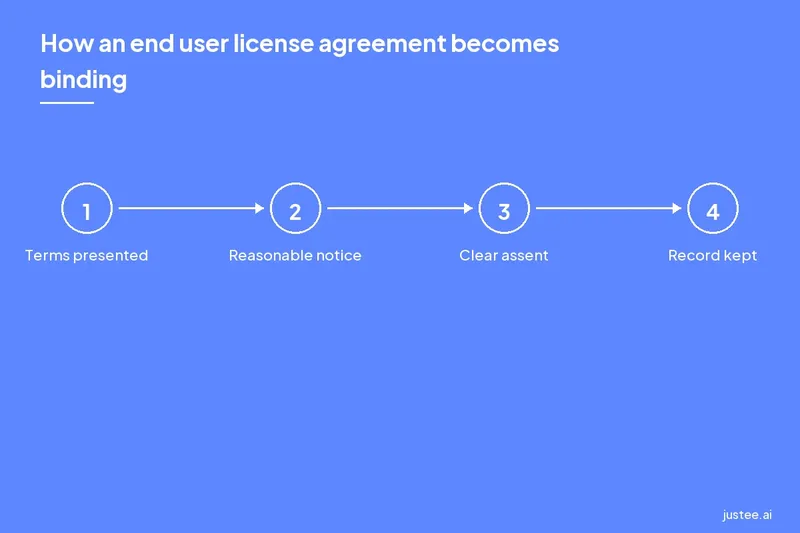
Term 1: the acceptance method. A EULA is only a contract if the user agreed to it, and U.S. courts have spent three decades sorting out what counts as agreement for software and online terms. The cases fall into a few patterns.
- Shrinkwrap. Terms packaged with physical software and accepted by keeping or using it. In ProCD v. Zeidenberg (1996), the Seventh Circuit enforced a shrinkwrap license where the buyer had the chance to read the terms and return the software.
- Clickwrap. The user has to click “I agree” or check a box before continuing. Courts generally enforce clickwrap terms when they were presented clearly before the click.
- Browsewrap. The terms sit behind a link, and use of the site or software is said to be acceptance. In Specht v. Netscape (2002), the Second Circuit declined to bind users to license terms they could see only by scrolling below the download button. In Nguyen v. Barnes & Noble (2014), the Ninth Circuit declined to enforce a browsewrap without evidence that the user had actual or constructive notice of the terms.
- Sign-in wrap. A notice such as “by creating an account, you agree to the Terms” next to the sign-up button. In Meyer v. Uber (2017), the Second Circuit enforced this kind of notice where the screen was uncluttered and the link was reasonably conspicuous.
The common thread is reasonable notice and a clear act of assent. For a person accepting a EULA, the terms shown at the moment of the click are usually the terms that matter, and saving a dated copy or screenshot of them is a common practice, because publishers update their agreements and the version accepted can become hard to find later. For a business that publishes software, the same cases explain why so many installers use a scroll-and-click step. Our guide to reviewing a contract before signing covers the general steps that apply to any agreement.
A practical point for business buyers: the employee who clicks “accept” may bind the company even without formal signing authority, depending on the circumstances and state agency law. Many companies adopt a simple internal rule about who may accept software terms on the company's behalf, and route any EULA with fees, data access or audit rights through one person who keeps the records.
Terms 2 to 4: license scope, restrictions, ownership and reverse engineering
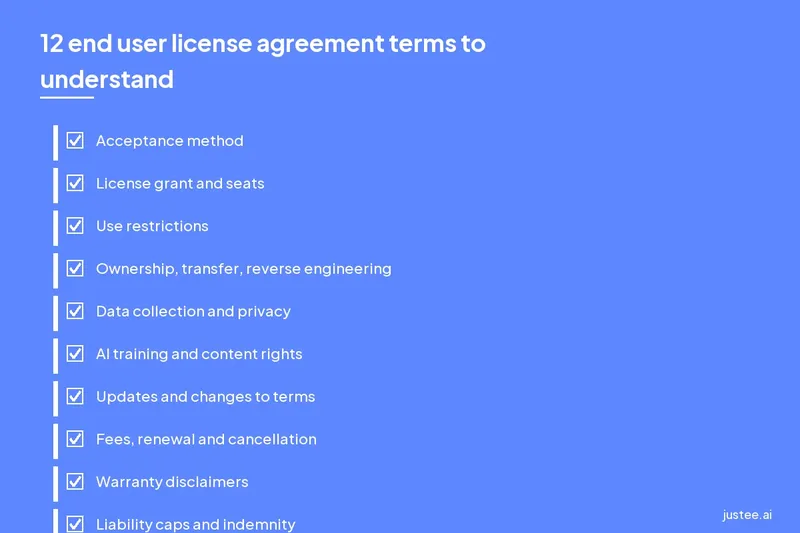
Term 2: the license grant. The grant clause defines what the user may do. A typical grant is limited, non-exclusive, non-transferable and revocable, and it often restricts use by number of devices, named users, concurrent users, locations or purpose. A license “for personal, non-commercial use” can be a problem for a freelancer or small business that uses the same app for client work. Business licenses may separately define “Authorized Users” to include or exclude contractors, affiliates and outsourcing providers. The grant is also where readers look for the length of the license: perpetual, subscription-based, or tied to a hardware device.
A typical grant reads something like this:
“Subject to your compliance with this Agreement, Licensor grants you a limited, non-exclusive, non-transferable, revocable license to install and use one copy of the Software on a single device owned or controlled by you, solely for your internal business purposes.” Illustrative example; have a lawyer adapt any clause to your contract and state.
Term 3: restrictions. Restrictions usually list what the license does not allow: copying beyond backup, sublicensing, renting, modifying, removing notices, using the software to build a competing product, publishing benchmark results, or exceeding usage limits. Readers often check whether a restriction conflicts with how the business actually plans to use the tool. A benchmarking ban, for example, matters to a consultancy that evaluates software for clients, and a ban on automated access matters to a team that plans to connect the software to other systems.
Term 4: ownership, transfer and reverse engineering. Most EULAs state that the publisher keeps all rights not expressly granted, that the license cannot be transferred without consent, and that the user may not decompile or reverse engineer the software. Federal law has a narrow interoperability exception in the Digital Millennium Copyright Act at 17 U.S.C. § 1201(f), which allows certain circumvention to achieve interoperability of an independently created program. Contract terms can still matter: in Bowers v. Baystate Technologies (2003), the Federal Circuit enforced a shrinkwrap license clause that prohibited reverse engineering. The U.S. Copyright Office also runs a Section 1201 rulemaking every three years that sets temporary exemptions for specific uses.
Ownership language deserves a second look when the software creates things. Design tools, code generators and AI products often include clauses about who owns the output, whether the publisher may use it, and what happens to templates or models the user builds. The same questions come up when a business moves from one tool to another and wants to take its work with it. Our licensing agreement review page covers negotiated intellectual property licenses in more depth.
Read an end user license agreement with AI
Paste the text or upload a PDF or DOCX and get findings rated Critical, Moderate or Note, typically in 1 to 6 minutes. Legal information, not legal advice.
Review a EULANo credit card requiredResults in minutesAES-256 encryption
Terms 5 to 7: data collection, AI training and changes to the terms
Term 5: data collection and privacy. Modern EULAs usually let the software collect usage data, device information, crash reports and, for cloud products, the content users upload. The details often sit in a separate privacy policy that the EULA incorporates by reference. Readers commonly check what is collected, whether it is shared or sold, whether the publisher may use it for its own purposes, how long it is kept and whether it can be deleted. The Federal Trade Commission treats misleading privacy promises as deceptive practices under Section 5 of the FTC Act; its privacy and security business guidance explains how that works. State privacy laws in California, Virginia, Colorado and other states add rights to access and delete personal data.
Term 6: AI training and content licenses. A newer clause gives the publisher a license to use customer content or usage data to train or improve machine learning models. Some EULAs make this opt-in, some opt-out, and some exclude business accounts. In February 2024 the FTC warned that companies which quietly change their terms to allow broader data use, including AI training, may be engaging in unfair or deceptive practices; see the agency's post on quietly changing terms of service. For a business, this clause matters most when employees upload client files, contracts or personal data into a tool. Many teams reduce how much personal data reaches a third-party AI model by redacting documents first; our PII redaction tool page explains one way to do that, and it is a step that reduces exposure rather than one that makes a workflow compliant with any privacy law.
Term 7: updates and changes to the terms. Most EULAs let the publisher push software updates automatically and change the agreement itself, often with notice by email or an in-app message and acceptance by continued use. Courts have been more skeptical of unilateral changes when notice was weak, but the outcome depends on the facts and the state. Readers often check how notice is given, whether there is a window to reject the change and cancel, and whether a change applies to disputes that already exist. When a vendor sends a new version, comparing the two side by side is often the fastest way to see what moved.
Justee is designed to help people understand what a document says before they accept it. It assists judgment; it does not replace the advice of a lawyer.
Terms 8 to 10: fees and renewal, warranty disclaimers, liability caps and indemnity
Term 8: fees, automatic renewal and cancellation. Subscription EULAs usually renew automatically. The FTC's Click-to-Cancel rule, which would have set federal standards for cancelling subscriptions, was vacated by a federal appeals court in July 2025, so state automatic renewal laws remain the main source of rules. California's Automatic Renewal Law, including Business and Professions Code section 17602, requires clear disclosure of renewal terms and affirmative consent, and amendments effective July 1, 2025 added rules on cancellation and reminders. Many other states have their own versions, and several apply only to consumers, not business accounts. Readers often check the renewal date, the notice window for cancelling, whether prices can rise at renewal and whether prepaid fees are refundable. Our automatic renewal clause guide goes deeper on this term.
Term 9: warranty disclaimers. Most EULAs provide the software “as is” and disclaim implied warranties of merchantability, fitness for a particular purpose and non-infringement. Where UCC Article 2 applies, UCC § 2-316 requires a written disclaimer of merchantability to mention merchantability and be conspicuous, which is one reason these sections are often printed in capital letters. Some states limit warranty disclaimers in consumer transactions. Business licenses sometimes include a limited warranty, such as substantial conformity with the documentation for a set period, with repair, replacement or a refund as the only remedy.
Term 10: liability caps and indemnity. A limitation of liability clause typically excludes indirect and consequential damages and caps the publisher's total liability, often at the fees paid over a recent period or at a small fixed amount for free software. Readers often check whether the cap is mutual, whether there are carve-outs for data breaches, confidentiality or intellectual property infringement, and whether the user also agrees to indemnify the publisher, for example for misuse or for content the user uploads. An IP indemnity from the publisher, a promise to defend the user if the software infringes someone else's rights, is common in business licenses and less common in consumer ones. Our limitation of liability clause guide explains how caps and carve-outs interact.
Terms 11 and 12: audits, export rules, termination and disputes
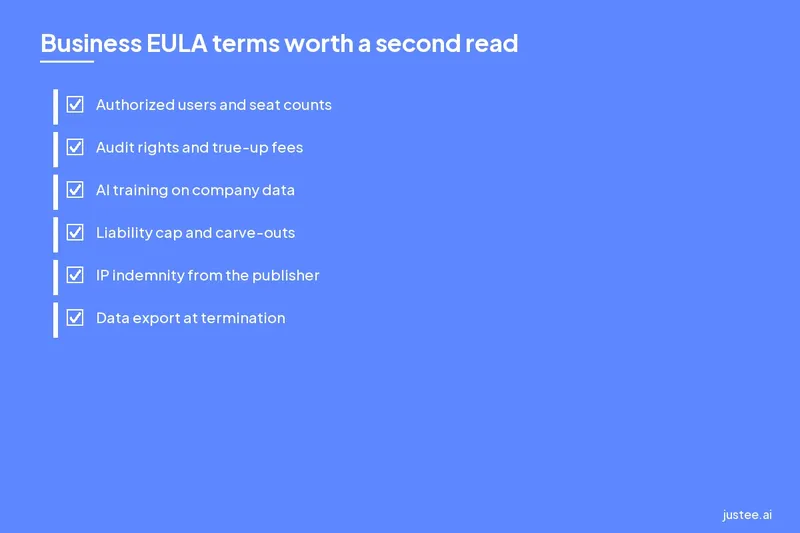
Term 11: audits, true-ups and export compliance. Business EULAs, especially for desktop and server software, often give the publisher the right to audit how many copies or users the customer has, sometimes through a third-party auditor, with a requirement to pay for any shortfall and, in some agreements, the cost of the audit if the shortfall passes a threshold. Readers often check notice periods, how often audits can happen, who pays, and whether the customer can review the auditor's findings before paying. Many EULAs also require compliance with U.S. export controls. The Export Administration Regulations, at 15 C.F.R. Parts 730 to 774, restrict exports of some software and encryption items to certain countries and parties, and a EULA usually makes the user responsible for its own compliance.
Term 12: termination and dispute resolution. The termination clause explains when the license ends: for breach, for non-payment, at the end of a subscription, or at the publisher's discretion. Readers often check what happens to data at termination, whether there is a window to export it, and which clauses survive. The dispute clause sets governing law, venue and, very often, mandatory arbitration with a class action waiver. The Federal Arbitration Act, 9 U.S.C. § 2, makes written arbitration agreements generally enforceable, and in AT&T Mobility v. Concepcion (2011) the U.S. Supreme Court held that the Act preempted a California rule that had treated many consumer class action waivers as unconscionable. Many arbitration clauses include an opt-out window after acceptance, a small claims carve-out and rules on who pays fees. Whether a particular clause is enforceable against a particular user is a question for a lawyer.
Governing law matters more than it looks. A EULA governed by the law of the publisher's home state, with courts there as the only venue, can make a dispute expensive to bring for a customer based elsewhere. Our contract review checklist covers the boilerplate clauses that appear across contract types.
How to read an end user license agreement with AI-assisted review
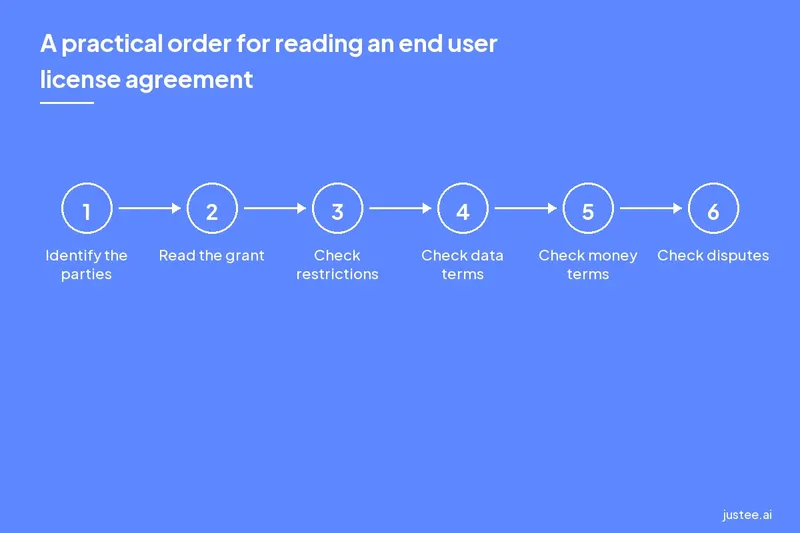
Most EULAs are long, and most of their terms are routine. The goal of a first read is to find the few terms that matter for a specific use, then decide which questions need a lawyer. A practical order is to identify the parties, read the grant and restrictions, then check data, renewal, liability and disputes. Justee's EULA review follows a similar path for an end user license agreement: it reads the document and lists terms to understand, each rated Critical, Moderate or Note.
According to Justee, the review accepts a PDF or DOCX file, including scanned PDFs, or pasted text, which helps with EULAs that exist only as a web page or an in-app screen. According to Justee, reviews typically take 1 to 6 minutes. Any U.S. state can be selected for the review, with 1 jurisdiction per document on the free trial and up to 2 on paid plans, and the review draws on a reference library of over 1 million sections of U.S. and England & Wales legislation.
Two other tools fit EULA work. When a vendor sends an updated version, Justee Document Comparison accepts PDF, DOCX and TXT files and lists the changes by type: insertion, deletion, replacement and visual change. It is rule-based, not AI, and it shows what changed rather than explaining what a change means, so new clauses can then be run through a review or taken to a lawyer. For general questions, such as what a class action waiver is or how the first-sale doctrine works, Justee Legal AI Chat gives general legal information; it does not draft letters or filings for a user's matter. Our document comparison and legal AI chat pages explain each tool.
On privacy: according to Justee, documents are processed on Justee's servers, hosted on AWS and encrypted in transit (TLS 1.2+) and at rest (AES-256). Guest files are deleted after 24 hours, and reviews in an account are kept until the user deletes them. Full Private Mode is optional on all paid plans: Justee's servers process the document, then seal the result with a key only the user holds, and it covers only the items made with it on. Details are on the Private Mode page. Plans run from $16/month to $149/month, billed annually (monthly billing costs more), as listed on the pricing page.
Justee lists the terms in an end user license agreement that are worth understanding, rated Critical, Moderate or Note. It is legal information, not legal advice, and a lawyer is the place to get advice on any contract.
AI review has limits. It can misread an unusual clause, and it does not know how a business actually uses a tool, which other contracts sit alongside the EULA, or what a lawyer would advise. It is not a substitute for the advice of an attorney; for advice on any contract, routine or not, talk to a lawyer.
Reading an end user license agreement yourself vs. AI-assisted review
| Step | Reading it yourself | AI-assisted review |
|---|---|---|
| Finding key terms | Full read and note-taking | Terms to understand are listed |
| Rating what matters | Your own judgment | Rated Critical, Moderate or Note |
| Web-page EULAs | Read on screen or print | Paste the text into the review |
| Updated versions | Compare versions by eye | Justee Document Comparison lists changes by type (rule-based) |
| Time | Depends on length | Typically 1 to 6 minutes |
| When to talk to a lawyer | For advice on any EULA, routine or not | Same: the review is information, not advice |
* AI-assisted review is legal information, not legal advice, and can misread unusual clauses. Justee Document Comparison is rule-based and does not use AI. For advice on any contract, routine or not, talk to a lawyer.
“In my view, the end user license agreement is the contract people accept most often and read least. Most of its terms are routine. A few, such as how data is used, how renewal works and where disputes go, can matter long after the install. I think a structured first read is most useful when it helps someone see those few terms clearly and bring the right questions to a lawyer.”
That is the idea behind Justee's EULA review: list the terms worth understanding, rate them Critical, Moderate or Note, and leave advice on any specific agreement to a lawyer.
Frequently Asked Questions
Is an end user license agreement legally binding?
Usually, if the user had reasonable notice of the terms and clearly agreed, for example by clicking “I agree.” U.S. courts generally enforce clickwrap EULAs and have refused to enforce terms that users could not reasonably see, as in Specht v. Netscape. Whether a specific clause is enforceable against a specific user depends on the wording, the facts and state law, which is a question for a lawyer.
What is the difference between a EULA and terms of service?
A EULA licenses the software itself and sets rules for installing, copying and using it. Terms of service govern an online service, such as accounts, content, acceptable use and payment. Many cloud products combine both in one document, often with a separate privacy policy.
Can software covered by a EULA be resold or transferred?
It depends on whether the user owns a copy or only holds a license. Many EULAs prohibit transfer without the publisher's consent, and in Vernor v. Autodesk the Ninth Circuit treated users as licensees when the agreement granted a license, significantly restricted transfer and imposed notable use restrictions. A lawyer can advise on a specific situation.
Can a software company change its EULA after it has been accepted?
Many EULAs allow changes with notice, often accepted by continued use. Courts have looked closely at whether that notice was adequate. The FTC has warned that quietly changing terms to allow broader data use, including AI training, may be unfair or deceptive. Comparing the old and new versions shows what changed.
Does accepting a EULA let a company train AI on uploaded data?
Only if the agreement or its privacy policy grants that right. Some EULAs make AI training opt-in, some opt-out and some exclude business accounts. The data and content license sections, and any linked privacy policy, are where that permission usually appears.
Can Justee review a EULA that only appears on a website?
Yes. According to Justee, the review accepts PDF or DOCX files, including scanned PDFs, or pasted text, so the text of a web page or in-app agreement can be pasted in. Findings are rated Critical, Moderate or Note.
Is a Justee review legal advice?
No. Justee is not a law firm. A review is legal information that helps a reader understand what an agreement says. For advice on any contract, routine or not, talk to a lawyer.
Understand the terms before you click accept
Justee's AI-assisted review lists the EULA terms worth understanding, rated Critical, Moderate or Note. Free use has page, state and usage limits; see pricing for plans.
Start a EULA reviewAn end user license agreement is easy to accept and easy to forget, but a handful of its terms, the grant, data use, renewal, liability and disputes, can shape how a business uses a tool for years. Reading those terms before clicking accept, saving a dated copy and comparing new versions when they arrive are common habits for teams that rely on licensed software. Justee's AI-assisted review of an end user license agreement is designed to make that first read faster and more structured; it is legal information, not legal advice. For subscription software bought on negotiated terms, see our SaaS agreement review.
Max Zaykov is the founder of Justee.ai, an AI tool that helps people understand their legal documents.
Justee is not a law firm. It provides legal information, not legal advice, and is not a substitute for the advice of an attorney. For advice on any contract, routine or not, talk to a lawyer.